Category Archives: musings

Hop Against Homophobia: It’s Personal

Hi there! Thanks for stopping by my blog. I’m happy to be participating in the Hop Against Homophobia, and I’m even happier that you’re taking the time to check out my contribution. I’m going to address the serious part of why I’m here first, and then I’ll get to the fun stuff. šŸ™‚

When I started thinking about what I wanted to say in this post, I kept coming back to the same beginning point: Christianity. I’m not trying to start a deep, philosophical discussion. I’m just making a public statement about my personal beliefs.

I’m Christian.

No, wait, don’t leave! That’s the biggest problem I see: as soon as I mention being Christian, a lot of people tune me out, or don’t believe me. Not that I can blame them, but the truth is that I’m Christian, I write same-sex romance, I support marriage equality, and I don’t think there’s anything wrong with being gay or with same-sex relationships. And there are a lot more people like me out here than you’d expect.

Yes, I realize it’s the far-right Christians* who get all the press. They’re the ones making all the noise, ignoring every issue on the political spectrum other than homosexuality and abortion. They push laws to ban same-sex marriage, deny civil rights to homosexuals, and rant and rave about how The Evil Gays should be punished and shunned.**

They’re not just homophobic. They’re flat-out wrong, and on several different levels.

Let’s start here: what if they were right, and God did condemn homosexuality? If so, then homosexuality and/or homosexual behaviors would be a sin, but a sin like any other. I’m a big believer that you can’t cherry-pick pieces of the Bible out of context. If you use a passage from Leviticus to condemn homosexuality, then you’d better not be eating pork or wearing a cotton-polyester blend. So, if homosexuality were a sin, then it would be no different from any of the other myriad sins. If homosexuals should be punished and shunned, even killed, then the people who so vocally condemn them would deserve the same.

But as I said, I’m not looking for a deep debate here. This is about me and my beliefs, and I personally do not believe homosexuality or homosexual behaviors are sinful. Sexual orientation is not a choice, it’s not a mistake, and it’s not wrong.

So why don’t you hear more about people like me? It’s hard to be heard over the yelling of the far right, for starters. The squeaky wheels get the press. And the more moderate, progressive Christians have to be very careful what we say and how we say it. We’re already lumped in with the fundamentalists as soon as we open our mouths. Yelling only makes it worse, because then even those who might have been willing to listen turn away.

We do what we can. That usually means working behind the scenes, fighting against unjust laws, fighting for social justice. It means setting a good example, both for other Christians and for non-Christians. It means behaving as much like Christ as we can, which means loving and caring for everyone, not just those who agree with us.

It also means accepting the possibility that we’re wrong, about this or any number of other subjects. None of us is perfect, and none of us has perfect insight. But I don’t believe God condemns love. We aren’t bodies with souls; we’re souls with bodies, and love is between two souls, regardless of the bodies that contain them.

*I won’t qualify this label. Above all else, I don’t believe it’s my place to judge the status of another person’s faith.
**And how women should be barefoot and pregnant in the kitchen, but that’s a different subject.

~~~~

And now the fun stuff!

In honor of the Hop, I’m offering up the whole kit and kaboodle: one PDF copy of every story I’ve published (full list here). To win, justĀ post a comment below, with your email address so I can contact you if you win. I’ll pick one winner at random from all comments received from now through Sunday, May 20.*** If the winner already owns any of the stories, then I’ll pick another winner for the remaining ones, until all 10 stories are gone.

Good luck, and be sure to check out the other posts over the weekend!

***Based on the timestamp of the comment.

~~~~

Whoops! Ā I neglected to cite the source for a quote I paraphrased in my post: “You don’t have a soul. You are a soul. You have a body.ā€ ― C.S. Lewis

Help A Panel Virgin Out?

I’m prepping for my first-ever convention panels, and I had a few questions I wanted to ask for help with. Feel free to answer in comments or email me at shaeconnorwrites@gmail.com. šŸ™‚

1. Published authors: Did you start out writing fanfic (or do you still write fanfic)? How did you make the transition? Have you ever taken a story or story idea from one of your fanfic works and repurposed it for an original fic?

2. Readers: What are your favorite romance stories with BDSM or any similar harder-edged themes? (Any pairings-or-more welcome: M/M, M/F, F/F, menage; would particularly like any F/F recs. Feel free to recommend your own!)

3. Authors with day jobs: How much time on average are you able to devote to your writing career? (All aspects, not just writing.) Do you hope to be able to quit the day job eventually in favor of full-time writing?

Thank you for any help you can give! I’ll credit any comments I use, of course, so please let me know if you’d rather be anonymous. šŸ™‚

Rationalization Expert

I tell myself adding WIP word counts and upcoming appearances to the sidebar here is a way to keep myself more accountable.

Truth is, it’s just another way to procrastinate.

Sigh.

Dirty Little Secret

A couple of discussions recently have centered around fanfiction writers who’ve moved into the original publishing world. That in itself isn’t frowned upon—unless they bring any stories along with them. Taking a story that was originally written as fanfiction andĀ converting itĀ into a story that stands on its own is… cheating, I guess?

I say “I guess” because I don’t get it. I understand it if the resulting storyĀ doesn’t stand alone. WhenĀ copyrighted source material is reused, that’s not okay. The vast majority of fanfiction, assuming it’s well done at all, is much too closely tied to the source material for the author to have any prayer of prying it loose completely. It’s a bad idea to even try. And if you do, you piss people off, and you make other fanfiction authors look bad. And that’s also not okay.

But if the source material is completely left behind,Ā I don’t think there’s anything wrong with converting a fanfiction story intoĀ original fiction. If you take only the originalĀ parts of the story,Ā parts that did not come from the source material,Ā and rebuild the rest of it from scratch, then you can end up with something that’s totally original and completely yours. (And if the original source isn’t copyrighted,Ā you’ve got even more latitude. Derivative fiction is a time-honored literary tradition. How many different variations on Romeo and Juliet are floating around out there by now?)

The disclaimer here, of course, is that I’ve converted fanfiction into original fiction. The fanfiction stories in question were “alternate universe,” soĀ they had little in common with the source material to start with. I stripped out the parts that came from the original source and used the remaining shell to rebuild a completely original story. And trust me: that involved a hell of a lot more than just changing names. Imagine those house-flipping shows where they tear a house down to the bareĀ frame and rebuild it from there. That’s what it’s like.

To be perfectly clear: everything I’veĀ published is my original work, and I stand by it. If admitting that I’veĀ reused parts of a few of myĀ fanfiction storiesĀ loses me readers, well, so be it. You can’t please everyone.

Help an Editor Out

My day job is editing. A totally different type of editing from fiction, but editing nonetheless. So when I read Theresa Stevens’ post at Romance University, it was all I could do to keep from standing up and cheering. (If I didn’t have a lapdesk and laptop in my, well, lap, I might have done it anyway.)

In particular, this passage:

Here’s a sad truth. When I evaluated a submission, the first question in my mind was not, Is this story good enough to publish? My first question was, How many hours of my life will it take to get this manuscript ready? If every other paragraph contains a grammar or usage error, that translates into time that I could be spending on other tasks.

This is why it’s easy for an editor to equate bad grammar with other flaws: arrogance, lack of self-respect, lack of respect for us, disdain for the product you’re creating. If you don’t care enough to distinguish possessives from plurals, then we’re not going to care enough to give you anything more than a form rejection.

In other words, if you don’t worry about your grammar, neither will I.

I have never understood the lack of regard many professional authors appear to have for proper grammar and usage. I’m not talking about off-the-cuff tweets and such (although I still cringe sometimes). I’m not even talking about errors and typos; everyone makes those (me included). I’m talking about failure to take the time to make actual manuscripts as clean and error-free as you can possibly make it, before you submit.

Sure, there are many great storytellers who are terrible spellers or can never remember when to use its vs. it’s. Everyone has foibles. But authors need to recognize their weak spots and do what they can to overcome them, whether it’s studying up on grammar or finding a personal editor who’s a whiz at it to fix things before submission. (Relying on spellcheck and grammar check won’t cut it.) Heck, I’m the one people I know come to for grammar questions, and I almost never submit anything without having at least two other people read it first.

Editors can’t fix everything. Give them a hand, and everyone (including your readers!) will be much happier for it.

Pen image via http://www.sxc.hu

The Required End of the Year Post

So, 2011 is ending. Like many years, it’s been quite a rollercoaster, but for me, at least, it ended up on the plus side overall. I published my first novel, along with a half-dozen short stories, met a bunch of great people online and at three different conventions, read a lot of great stories, and got a hell of a lot of writing done. And that’s just on the writerly side of things.

Here are some random thoughts about random things.

In 2011, I published approximately 138,250 words. I can’t even attempt to estimate how many words I wrote (well over half of those published were written in 2010), so this is the best litmus test I have. I also made a bunch of great new friends through the writing community, many online and many in person (and some both!), and that’s worth more than any royalties, in my book. šŸ™‚

GayRomLit was an absolute blast, and I can’t wait for year 2 in Albuquerque. I also had a great time with author friends at Gaylaxicon/Outlantacon and at Dragon*Con.

A few favorite M/M romance books from this year, not even close to exhaustive and in no particular order except that’s how they occurred to me…

Caregiver by Rick R. Reed
Another Enchanted April by Eric Arvin
Accompanied by a Waltz and Seven Days by Andrew Grey
By Any Other Name by Tia Fielding
What We Deserve by Kerry Freeman
Clear Water by Amy Lane
Hot Head by Damon Suede
Dance with Me by Heidi Cullinan
Between Sinners and Saints by Marie Sexton
Once in a Lifetime by Ariel Tachna
Rocking the Boat and Tipping the Balance by Christopher Koehler
In Dreams He Came by Trina Lane
All Bets are Off by Marguerite Labbe
Love at First Sight by Cardeno C.

For 2012, my main goal is simple: keep writing. But I’m going to spend the first few days/weeks making some more concrete goals. I have the NaNo project to finish, another novel undergoing heavy revision, and a series (three books minimum) that keeps nagging at me. I have a novella coming out in February, but I want to concentrate more on long stories, especially novels, for a number of reasons, but mostly because, well, why not? I did it once, so I can do it again, right? šŸ˜‰

More than anything, though, I want to keep having fun with all of this. If I push too hard, it becomes, well, work. And for now, at least, I’d rather stick with just the day job feeling like work!

Happy New Year to all, and hope we all have a safe, healthy, happy, and successful 2012. šŸ™‚

Out on a Limb

I debated saying anything about this, until one part of my brain smacked the other and said JUST DO IT ALREADY, JEEZ. (This post not sponsored by Nike.)

I’ve been reading various posts by various people in the M/M romance community (by which I mean, anyone who reads or writes in the genre) regarding transgender authors and how they represent themselves. The current discussion grew out of what was—let’s be honest here—an attack by a specific person against a specific author. This person felt the author in question had been lying about his gender because he was, in fact, born a biological female.

There’s really only one thing I can think of to say to that.

BULLSHIT.

The author in question is a man. He lives as a man and uses a male identity. Calling himself a man is no more a lie than it is for me to call myself—a cisgender biological female—a woman.

The physical states of our bodies have nothing to do with it. And, more than that, unless they choose to inform you of it, the physical state of someone else’s body is none of your damn business.

Being transgender, in simplest terms, means that you self-identify as a gender other than your biological sex. It is a born trait, just like sexuality, and I don’t think it’s exaggerating to say that coming out as transgender is likely to be even more difficult and traumatic than it can be to coming out a gay or bisexual. Exhibit A: The reactions some people have had to the discussion we’re currently having.

I’ve seen several comments by transgender authors and readers, and many by other authors and readers, most of them (thankfully) in support of transgender authors. However, it’s been extremely disheartening to witness the degree of vitriol I’ve seen directed at transgender people by members of a community that you would think by its very nature would be more understanding and compassionate than the general public.

Well. I suppose it is still better than the general public (Exhibit B: The Republican Presidential field), but it’s nowhere near what it ought to be.

As I said above, I am a cisgender biological female, which means that my biological sex and my gender identity match. I generally describe myself as ā€œstraight but not narrowā€; more specifically, I’m probably a 1.5 on Kinsey (almost but not necessarily exclusively straight). I read and write M/M romance of different varieties. I have friends who are straight, gay, and at all points of the spectrum in between. I have transgender and polyamorous friends.

(Note: Microsoft Word does not recognize ā€œpolyamorousā€ or ā€œpolyamory.ā€)

I was also raised in a conservative Christian family in the Deep South. I grew up surrounded by intolerance of all sorts, much of it disguised as ā€œtradition.ā€ But thankfully, I also had parents who taught me to think for myself—even if my thoughts disagreed radically from theirs, as they often did, and still do.

When I was 11 years old, I told my grandfather to please stop using ā€œthe N-wordā€ around me. My grandfather was a wonderful, brilliant, funny, and loving man, but he grew up in a society where anyone non-white was considered inferior, and he’d been using that word all his life (although never to a black person). He was also very stubborn and didn’t take well to being told what to do.

I never, not for the next 18 years until he died, heard him use that word in my presence again.

I’m telling you these things about myself to make this point (and yeah, maybe it’s a little snotty of me, but hey): If someone from a background like mine can figure this kind of thing out, with little support or direction, it should not be so hard for others to do it, especially with the kinds of information and support structures that surround us now. And especially not in this genre, of all places. All it takes is a little backbone, a little thought and compassion—and, particularly in this specific case, a little less nosiness about other people’s private lives.

So can we try that now? Please? ’Cause I’d really much rather we spend our time reading and writing about men falling in love.

(Or lust. That works too.)

Tybee Memories

IĀ love the outdoors. Well, at least, I do when the weather is nice. The kind of heat we’ve had the summer doesn’t really fit the bill. But when it’s a reasonable temperature for whatever outdoor activity I want to do—hiking, running, walking, just sitting around—I couldĀ almost stay outside forever. Being outdoors is what recharges my batteries faster than anything else.

I particularly like being around water. I’d much rather be on or near the water than in the water; I’m not a big swimmer. But sitting on a dock by a lake, or near a river, or on a boat, or on the beach—it’s all a slice of heaven to me.

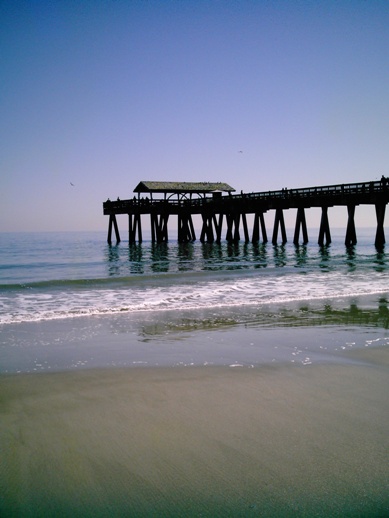
The pier at Tybee IslandThat’s part of the reason I set Sand & Water primarily on Tybee Island. Tybee sits off the Georgia coast at Savannah, in the curve of the Southeastern shoreline. I grew up in South Georgia, and over the years I’ve made lots of trips to Georgia’s barrier islands. I’ve spent more time on St. Simons and Jekyll Islands, but I have a soft spot for Tybee.

The last time I visited was about 5 years ago, on a weekend trip to Savannah with my sister. We spent most of a day on the island, eating lunch at Stingray’s and hitting the Marine Science Center, walking on the pier and the beach. While we were there, I took the two images that were used on the cover of Sand & Water, of the beach and the pier (the latter is the picture with this post). The beach shot is also the one used for the header here and in some of the promotional materials I’ve had made.

Like most beach spots, large or small, Tybee has its fair share of kitsch and tourist-related annoyances. A Miley Cyrus movie was filmed there since my last visit, and I’m sure that wasn’t a whole lot of fun for the locals and has surely added a layer to the tourist-trappiness. But Tybee has the laid-back, small-town feel that most beach towns do, with lots of local businesses and restaurants, so it doesn’t have a ā€œDisney-fiedā€ feel that some places. Plus pretty much everything is within walking distance to the beach, and it’s hard to argue with that.

I use a few local businesses in Sand & Water. Tradewinds, which John mentions briefly, is a real ice cream store and coffee shop, and I’ve visited both the Marine Science Center and the snack bar on the pier. The location of Meghan’s restaurant, Let’s Be Shellfish, matches up with a seafood restaurant located along the beach, and the island has an Episcopal church too, but the versions of both in the novel are fully fictionalized. The specific locations of the homes and local parks described are also fictionalized, but Tybee has a number of Victorian-era houses like the house John, Beth, and Meghan share and the bed and breakfast where Bryan lives with his sister and her family. A lot of those have been restored in recent years, and that’s a wonderful thing to see.

Writing Sand & Water made me want to buy a place on Tybee eventually. I’d probably need to win the lottery or produce a major bestseller first, considering the real estate prices. But with the beach on my doorstep and the beautiful history of Savannah such a short drive away, it’s high up on my wish list.

Do This, Not That

I see a lot of writerly advice links floating around, mainly via the Twittersphere. Never do this! they say. That doesn’t work! Do this instead! And a heck of a lot of the YOU MUST DO THIS advice is contradictory.

My advice? Read it, sure, but take all of it with a nice, big grain of salt. Spend your time and effort figuring out what works for you.

Every writer is different, and every story is different. What another author does may not fit your schedule or your style. A short story isn’t a novel. Plots and characters can run away from you. Nothing is 100% for anyone.

Unfortunately, there’s no blood test for this. No one’s going to be able to look you over and tell you what you should do. Sure, there are clues here and there—How organized are you? Are you a computerphile or a technophobe? What’s your home life like?—but what it comes down to is trial and error.

Experiment. Try writing early in the morning or late at night. Challenge yourself to write for a certain length of time or certain number of words. Write in your living room, in bed, outside, longhand. Listen to different types of music while you write, or try silence. Write out character bios or build the world of your story before you write the story itself. Outline, or write a detailed summary, or just start writing and see what happens.* Write in present tense or omniscient or whatever your characters want from you.

[*Okay, one specific piece of advice: pantsing generally works better for short stories than long!]

In conclusion: go on already! Quit reading this and get busy writing! Sheesh. šŸ˜‰